Saturday, December 31, 2011

Scientists cure cancer, but no one notices....

Scientists cure cancer but no one takes notice.
Hubpages.com Sun, 15 May 2011 17:05 CDT Canadian researchers find a simple cure for cancer, but major pharmaceutical companies are not interested.

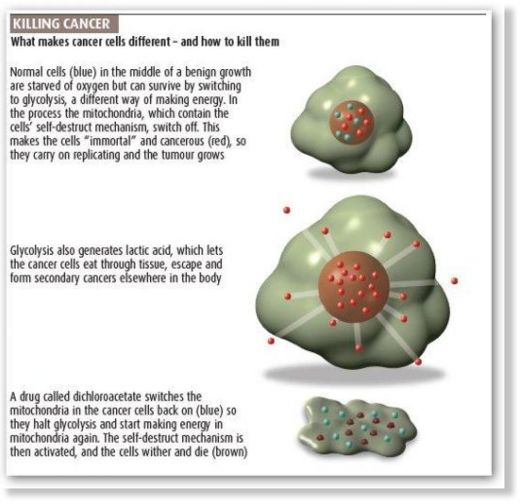
Researchers at the University of Alberta, in Edmonton, Canada have cured cancer last week, yet there is a little ripple in the news or in TV. It is a simple technique using very basic drug. The method employs dichloroacetate, which is currently used to treat metabolic disorders. So, there is no concern of side effects or about their long term effects.

This drug doesn't require a patent, so anyone can employ it widely and cheaply compared to the costly cancer drugs produced by major pharmaceutical companies.

Canadian scientists tested this dichloroacetate (DCA) on human's cells; it killed lung, breast and brain cancer cells and left the healthy cells alone. It was tested on Rats inflicted with severe tumors; their cells shrank when they were fed with water supplemented with DCA. The drug is widely available and the technique is easy to use, why the major drug companies are not involved? Or the Media interested in this find?

In human bodies there is a natural cancer fighting human cell, the mitochondria, but they need to be triggered to be effective. Scientists used to think that these mitochondria cells were damaged and thus ineffective against cancer. So they used to focus on glycolysis, which is less effective in curing cancer and more wasteful. The drug manufacturers focused on this glycolysis method to fight cancer. This DCA on the other hand doesn't rely on glycolysis instead on mitochondria; it triggers the mitochondria which in turn fights the cancer cells.

The side effect of this is it also reactivates a process called apoptosis. You see, mitochondria contain an all-too-important self-destruct button that can't be pressed in cancer cells. Without it, tumors grow larger as cells refuse to be extinguished. Fully functioning mitochondria, thanks to DCA, can once again die.

With glycolysis turned off, the body produces less lactic acid, so the bad tissue around cancer cells doesn't break down and seed new tumors.

Pharmaceutical companies are not investing in this research because DCA method cannot be patented, without a patent they can't make money, like they are doing now with their AIDS Patent. Since the pharmaceutical companies won't develop this, the article says other independent laboratories should start producing this drug and do more research to confirm all the above findings and produce drugs. All the groundwork can be done in collaboration with the Universities, who will be glad to assist in such research and can develop an effective drug for curing cancer.

You can access the original research for this cancer here.

This article wants to raise awareness for this study, hope some independent companies and small startup will pick up this idea and produce these drugs, because the big companies won't touch it for a long time.

Monday, December 19, 2011

One Hundred Million Dollar Penny

Debt or Taxes – the battle of our time

SOURCE Article (in part- please see source for full article)
Debt or Taxes – the battle of our time by Golem XIV on NOVEMBER 23, 2011 in LATEST ....................................................................................... Debt is to the free market and its political agenda as taxes are to democracy. Both are THE ultimate source of power for their respective worlds. Taxes are what gives governments their power. Debt is what gives banks and the financial system its power. It has no other. ..................................................... The power to tax your future work and wealth is what gives the government a guarantee of income and therefore of power stretching away in to the future. Debt does exactly the same for the world of private finance and ‘free markets’. Debt and taxes are in direct competition. They are both claims on the future, our future. ... .......................................................................... .... The competition is not just financial it is crucially political. Paying taxes supports the workings and power of nation states and ties us all to the nation state and to the politics of democratically electing governments. Taking on private debts whether personally or collectively, replaces loyalty to and concern for the nation state with concern for the banks and the private financial system they make up. Whichever of the two claims we are persuaded takes precedence and is the most important, takes hold of the reigns of power and has the final say in what we do today and where we are headed tomorrow. The system of private finance and debt is right now claiming that precedence and our politicians are helping them. We are being betrayed. ............................................................................................... ....... We are no longer making financial decisions within the context of a democratic system based upon nation states. We are choosing between that 19th century system and a new private-debt based system in which neither the nation state nor its democratic traditions have any standing nor power. The decisions that are being made for us and around us, often in spite of our voiced concerns, are transferring power from the nation state system to the private global financial system. From governance to management. From democracy to oligarchic technocracy. ............................................................................................... ....................... Bailing out the banks and the wider system of private debt finance is a directly political act. Though that is not being made clear. Perhaps it is even being deliberately disguised. We are told bailing out the banks is purely a matter of practical and expedient necessity. A temporary financial matter. It is not. It is a fundamental shift in power.
Friday, December 09, 2011

The Death of Common Sense

I take no credit for this: I am just echoing this powerful piece and passing it onwards.
Today we mourn the passing of a beloved old friend, Common Sense , who has been with us for many years. No one knows for sure how old he was, since his birth records were long ago lost in bureaucratic red tape. He will be remembered as having cultivated such valuable lessons as: - Knowing when to come in out of the rain; - Why the early bird gets the worm; - Life isn't always fair; - and maybe it was my fault. Common Sense lived by simple, sound financial policies (don't spend more than you can earn) and reliable strategies (adults, not children, are in charge). His health began to deteriorate rapidly when well-intentioned but overbearing regulations were set in place. Reports of a 6-year-old boy charged with sexual harassment for kissing a classmate; teens suspended from school for using mouthwash after lunch; and a teacher fired for reprimanding an unruly student, only worsened his condition. Common Sense lost ground when parents attacked teachers for doing the job that they themselves had failed to do in disciplining their unruly children. It declined even further when schools were required to get parental consent to administer sun lotion or an aspirin to a student; but could not inform parents when a student became pregnant and wanted to have an abortion. Common Sense lost the will to live as the churches became businesses; and criminals received better treatment than their victims. Common Sense took a beating when you couldn't defend yourself from a burglar in your own home and the burglar could sue you for assault. Common Sense finally gave up the will to live, after a woman failed to realize that a steaming cup of coffee was hot. She spilled a little in her lap, and was promptly awarded a huge settlement. Common Sense was preceded in death, by his parents, Truth and Trust, by his wife, Discretion, by his daughter, Responsibility, and by his son, Reason. He is survived by his 4 stepbrothers; I Know My Rights I Want It Now Someone Else Is To Blame I'm A Victim Not many attended his funeral because so few realized he was gone. If you still remember him, pass this on. If not, join the majority and do nothing.

Thursday, December 08, 2011

Rats Free Trapped Friends, Hint at Universal Empathy

Rats Free Trapped Friends
Rats Free Trapped Friends, Hint at Universal Empathy By Brandon Keim December 8, 2011 | 2:00 pm | Categories: Animals, Brains and Behavior With a few liberating swipes of their paws, a group of research rats freed trapped labmates and raised anew the possibility that empathy isn’t unique to humans and a few extra-smart animals, but is widespread in the animal world. Though more studies are needed on the rats’ motivations, it’s at least plausible they demonstrated “empathically motivated pro-social behavior.” People would generally call that helpfulness, or even kindness. “Rats help other rats in distress. That means it’s a biological inheritance,” said neurobiologist Peggy Mason of the University of Chicago. “That’s the biological program we have.” In a study published Dec. 7 in Science, Mason and University of Chicago psychologists Jean Decety and Inbal Ben-Ami Bartal describe their rat empathy-testing apparatus: An enclosure into which pairs of rats were placed, with one roaming free and the other restrained inside a plastic tube. It could only be opened from the outside, which is exactly what the free rats did — again and again and again, seemingly in response to their trapped companions’ distress. The experiment built on research conducted several years ago by geneticist Jeff Mogil at McGill University, where mice were shown capable of “emotional contagion” — a slightly scary-sounding term denoting a tendency to become upset when cagemates were in pain. This might not seem surprising, but anecdotes from wild animal observations don’t pass academic scrutiny, and it hadn’t before been shown in captive mice. It hinted at unexpectedly sophisticated cognition: Mice were supposed to feel pain, but not each other’s, at least not outside children’s stories. At the time, ethologist Frans de Waal of Emory University, whose work has helped redefine what’s known about thoughts and feelings in chimpanzees and dolphins and elephants, said Mogil’s experiment “justifies speaking of ‘empathy’” — the ability to both put oneself in the shoes, or paws, of another, and to become emotionally involved in their situation. Sure, mice almost certainly weren’t so empathic as humans, but maybe they had the seeds of it. Maybe empathy wasn’t the result of some high-powered cognitive process, as most biologists and psychologists preferred to think, but a relatively simple phenomenon. Wrote de Waal in Scientific American, “This mouse experiment suggests that the emotional component of this process is at least as old as the mammals and runs deep within us.” Still, it was hard to know what to think, and emotional contagion didn’t equal empathy. Maybe the mice were simply fearful for themselves. But the possibility was open for investigation. And around the same time as the McGill studies, Bartal — then researching cancer in Israel — noticed rats at her lab becoming distressed when surgeries were performed on other rats. She couldn’t shake the feeling that empathy was involved. When she read about a rat bringing food to a trapped rat, she again thought about empathy. Bartal went to the University of Chicago, where she joined with Decety, a leading scholar on empathy and prosocial behavior, and Mason, who’d been intrigued by Mogil’s work. Together they designed the new study — and not only did they find what might be empathy, but the rats acted on it. Once rats learned to free their trapped and agitated partners, they did so almost immediately in trial after trial. The behavior was clearly deliberate. When the restrainer was empty, rats ignored it. When stuffed rats were restrained, the rats ignored them. “It’s compelling evidence that it’s the distress of the trapped cagemate motivating this helping behavior,” said Mason. “It is a huge leap up to use emotional contagion to actually do something, to actually help another individual.” To make sure the rats weren’t responding to some immediate social reward — a rat version of a thank-you hug — the researchers tweaked the apparatus so that trapped rats were released into a separate cage. Again, the rats freed each other. When given the opportunity to eat chocolate treats first, rats were as likely to release their companions first, and even shared the chocolate with them. “Empathy is a truly powerful motivator, on a par with the desire for chocolate!” said de Waal, who was not involved in the new study. According to de Waal, the results “show for the first time that rodents are not just affected by the emotions of others, but that empathy motivates altruism.” He believes the rats responded to an instinctive urge to make their compatriots feel better, just as humans and chimpanzees and some cetaceans do. “The mechanism must ancient,” said de Waal. However, the researchers stopped short of ascribing the results to a conclusive display of empathy. It’s possible the rats were less concerned with alleviating the suffering of brethren than soothing their own upset feelings. Perhaps the trapped rats’ distress calls were simply loud and annoying, and the free rats wanted to quiet them. One potentially important experimental condition — the opportunity for free rats to simply leave — wasn’t tested. “The reservation I have is that it’s very difficult to demonstrate empathy. You have to show that the animal is putting itself in another’s shoes, and I’m not sure that’s demonstrated here,” said Joshua Plotnik, an Emory University psychologist and collaborator with de Waal. But Plotnik still called the observations “very exciting.” 'Nature made it rewarding for us to end the suffering of another.'According to Mason, further tests are planned in which rats’ stress responses will be damped by drugs. If a rat feels no distress itself but still frees a trapped companion, or if a trapped rat expresses no distress but is still rescued, empathy will seem more likely. “We can figure this question out. It’s completely tractable,” said Mason. “And this experimental model is unbelievably easy to set up. It’s our fervent hope this model will be used by many people to look at helping behavior.” Cognitive mechanisms thought to underlie empathy and helpfulness could be tested, Mason said. So could the effects of personality traits, sex differences — females rats seemed more helpful, which tracks with studies of chimps and humans — or genetic and environmental variables. Indeed, the tests needn’t be restricted to rats, but could involve any species amenable to captivity. For Bartal, whether rats were motivated by their companions’ distress or their own is less interesting than the simple fact they responded at all. “The bottom line here is that nature is very smart. Nature made it rewarding for us to end the suffering of another,” she said. While the researchers didn’t discuss mechanisms underlying the possible empathy, Bartal and de Waal suspect it’s linked to the lengthy care and nursing provided, as in all mammals, by mother rats. “Mammals that need nurture and care after they’re born would require some form of empathic connection between mother and offspring,” Bartal said. Sociality could be another important factor. Rats live in large family groups with complex hierarchies, and empathy is especially important in social settings. Rats also share basic neurological features, such as a highly developed limbic system and various hormones and neurotransmitters, with all other mammals. These could provide a common ancestral origin for empathy, said Bartal, or evolution could have shaped them independently in converging ways. All roads could lead to empathy. Of course, mammals don’t have a monopoly on intelligence or sociality or maternal care. Octopi are extraordinarily smart. So are many birds, which also care for their young and can live in large colonies. The seeds of empathy, if that’s what the rats have, could be scattered widely. “Nature has an interesting way of using different structures for similar functions,” said Bartal. Image: A rat helps another escape from a cage. (Bartal et al./Science) Citation: “Empathy and Pro-Social Behavior in Rats.” By Inbal Ben-Ami Bartal, Jean Decety, Peggy Mason. Science, Vol. 334 Issue 6061, Dec. 9, 2011.

Monday, October 10, 2011

It's about time...

About time: What is it? 10 October 2011 by Stuart Clark
Read more: "About time: Adventures in the fourth dimension" WHAT is time? It is a question that has occupied some of the greatest minds, from the ancient philosophers to the scientists of the Enlightenment and beyond. Yet after thousands of years of contemplation and scientific progress, there remains no consensus about its nature. "We can recognise time but we do not understand it," says philosopher Julian Barbour. "It is remarkable that there's so little agreement on what time is or even how to investigate a solution." This may be because a deep understanding of time has proved almost superfluous to our progress. In physics, for example, Newton's laws of motion, Einstein's general relativity and quantum theory do not require us to know the nature of time in order to make them work. Even clock-makers do not need to understand time. Clocks, however, do give us a clue about where to concentrate our efforts because a clock needs some kind of moving part to gauge the passing of time. This can be the tick-tock of an escapement, an oscillating quartz crystal or the ejection of a particle from a radioactive atom - one way or another, there must be movement. When something moves, it changes. So clocks tell us that time is inextricably linked somehow to change. Yet that only takes us so far. From this point, there are two paths that lead to completely opposing views of time. The first concludes that time is a real, fundamental property of the universe. Like space or mass, it exists in itself. It provides the framework in which events take place. This was the view taken by Isaac Newton, who realised that to quantify motion, you have to treat time as if it is as solid as the walls of a house. Only then can you confidently measure how far and how fast an object is moving. Einstein got rid of this notion of rigidity by showing that time passes at different rates depending upon an observer's motion and the strength of gravity pulling on them. His theory abandons the notion that space and time exist in themselves and he even went so far as to say "time is nothing but a stubbornly persistent illusion". Yet space-time can still provide a useful reference frame against which to measure the cosmos, or as physicist Brian Greene writes in his book The Fabric of the Cosmos: "space-time is a something". The second path leads to the idea that change is the fundamental property of the universe and that time emerges from our mental efforts to organise the changing world we see around us. Newton's great rival Gottfried Leibniz favoured this style of interpretation, which suggests that time is not real but created inside our brains. So we are faced with a conundrum: is time real? Physicists and philosophers are still very much debating the issue, not least because quantum mechanics muddies the issue further. One of the main reasons, though, is that the answers could lead us towards a "theory of everything" that would explain all the particles and forces of nature (see "Countdown to the theory of everything"). Another question looms large too. If time is real, where did it come from? Until recently, most physicists assumed that it was created in the big bang when matter, energy and space itself were born. Any notion that time existed before the big bang was therefore considered irrelevant. Now, however, they are not so sure. "We have no right to claim that the universe and time started at the big bang, or had some sort of prehistory," says Sean Carroll at the California Institute of Technology in Pasadena. "Both options are very much on the table, and personally I favour the idea that the universe has lasted forever." String theories are what have led to this re-evaluation. In these hypothetical extensions to standard physics, reality is composed of more dimensions than our familiar four. Although we cannot directly perceive these other realms, they provide places for alternate universes to exist. These universes bud off from each other in a perpetual sequence of big bangs, meaning that our universe was born from another and so time did exist before our big bang. Previous universes may even have left hints of themselves on ours. In 2008, Carroll and colleagues hinted that peculiarities in the radiation leftover from the big bang may be the signature of earlier universes (bit.ly/pA8D75). Last year Roger Penrose at the University of Oxford and Vahe Gurzadyan at Yerevan State University in Armenia went much further and argued that circular patterns in this cosmic microwave background (CMB) were evidence of a sequence of previous universes and big bangs (arxiv.org/abs/1011.3706). We will have an opportunity to test these ideas when the European Space Agency's Planck satellite releases its map of the CMB in a few years' time. For the moment there is simply no way of escaping the fiendish difficulty of these questions, nor can we conceive of the profundity their answers will one day bring. Now, more than ever, we have to face up to our ignorance about time.

Thursday, September 29, 2011

Thinking....Doggiestyle

Thinking Doggie-Style
Has our long shared history with dogs shaped their brains - and ours?
By David Hambling
December 2010

Photo by Etienne Gilfillan

FT271

A common – if unlikely – claim made by dog owners is: “He understands every word you say.” But scientists are increasingly finding that it might be truer than you think. The evidence suggests that the two species have moulded each other over a long period of co-evolution, and have developed sophisticated communications in the process.

Archæological findings show that dogs were first domesticated at least 10,000 years ago, with one find at the Goyet Cave in Belgium recorded in 2008 possibly pushing that back to 30,000 years. Genetic studies indicate that the process of domestication that split dogs from wolves may date as far back as 100,000 years. And the relationship may have started long before that, as some archæological finds put humans and wolves in the same place 400,000 years ago.

The aptly named biologist Wolfgang Schleidt suggests that the two came together in Northern Europe at a time when humans – either Homo sapiens or the earlier H.erectus or H.heidelbergensis – existed in small nomadic groups. Humans joined wolves in their following of migratory reindeer, and the two races of hunter-scavengers started working together.

The success of the wolf pack hinges on the members’ ability to work together without conflict and share the kill. Recent work with dogs shows that they have a sense of ‘fair play’, previously thought to be limited to primates. The experiment at the University of Vienna involved training dogs to extend a paw. The dogs were happy to perform this trick with or without a reward when on their own. But if they were with another dog which received a reward when they did not, the dogs quickly refused to play.

We don’t know yet whether wolves share this attitude. Some have suggested that dogs became attuned to fairness as an adaptation for living with humans. This seems questionable: the phrase “a dog’s life” dates back to the 17th century, meaning “a life of misery, or of miserable subservience”.

Perhaps humans gained their own notions of fairness from their companions during the period when the two worked together. Wolfgang Schleidt sugg­ests that “wolves and dogs, with their remarkable capacity for co-operation and loyalty, were both role models and companions on this long trek toward humanity.”[1]

Sherlock Holmes once noted the curious silence of a dog, which failed to bark in the night (clear evidence to the great detective that an intruder was known to the dog). However, what is really curious is that dogs bark at all. Barking is rare among wolves, whose vocal commun­ications are generally howls or growls. Barking appears to have been evolved to talk to people.

Barking is more effective at getting human attention than growling. Peter Pongracz, a behavioural biologist at Eotvos University in Budapest, has shown that the pattern of barking is different for aggression, loneliness and happiness. Pongracz’s team recorded hundreds of different barks from different situations. Not only were the barks consistently differ­ent depending on the dog’s emotional state, but even people who had never owned a dog were able to correctly interpret them. Our long association with them means that understanding dogs is hardwired into the human psyche.

Humans and dogs also share the ability to follow a gaze or gesture to see what someone else is looking at or indicating. This is very unusual in nature – even chimpanzees have trouble with pointing tasks. However, the same team at Eotvos University also showed that dogs are capable of following both gaze and pointing. This should not come as any great surprise when you consider what Pointers are bred to do. Wolves are also capable of learning the same tricks, but it is much harder for them: unlike dogs they are not used to looking at humans.

Again, it would be interesting to know if pointing or gaze-following is a natural skill in wolves that humans – being mere primates and a bit slow – gradually acquired over time.

Dogs also read human facial expressions. A team at the University of Lincoln has found that dogs show what is termed ‘left gaze bias’. This is the tend­ency, when looking at a human face, to look left (i.e. at the right-hand side of the face) first, and to spend more time looking at this side. Left gaze bias has already been established as a human trait and only occurs when looking at faces. The reason for it is that emotions register more clearly and more intensely on the right side of the face. And dogs have been around humans long enough to have face-reading in their genes.

However, while it might seem that dogs and humans have evolved to understand each other very well, there is one huge gap. Children under the age of five have very little understanding of dog body language or barks and can’t tell a happy dog from an angry one. An excited child may try to hug this big fluffy toy, with disastrous results. Dogs and small children should always be supervised; possibly ancient humans didn’t leave children alone with dogs the way their modern descendents are prone to. Or perhaps evolution still has some work to do.

So far, research into dog-human communication has only scratched the surface; but the indications are that, even if they don’t catch every word, dogs understand us very well indeed because they shaped our brains as we shaped theirs.


NOTES
1 WM Schleidt: “Apes